The challenge
As one of the world's leading fashion brands, H&M moves an enormous volume of apparel through thousands of stores. Fast stock turnover and a smooth customer experience depend on quick, accurate checkout and reliable inventory data.
In recent years H&M has gradually moved towards RFID-enabled retail, using UHF RFID tags to improve supply chain traceability and checkout automation. During the transition, however, stores carry both RFID-tagged and barcode-only items, creating a dual environment at the checkout.
The goal was to gain the benefits of RFID without changing the existing POS system or extensively retraining cashiers. This called for a single scanner able to read both RFID tags and barcodes within one workflow.
H&M identified three key problems:
- Mixed item environment: some items carry UHF RFID tags, others still use conventional barcodes, which would require two separate scanners.
- Checkout congestion: scanning barcodes one by one slows transactions at peak times and lengthens queues.
- Continuity and reliability: RFID tags can occasionally be damaged or unreadable, so an RFID-only solution risks interruptions.
The solution
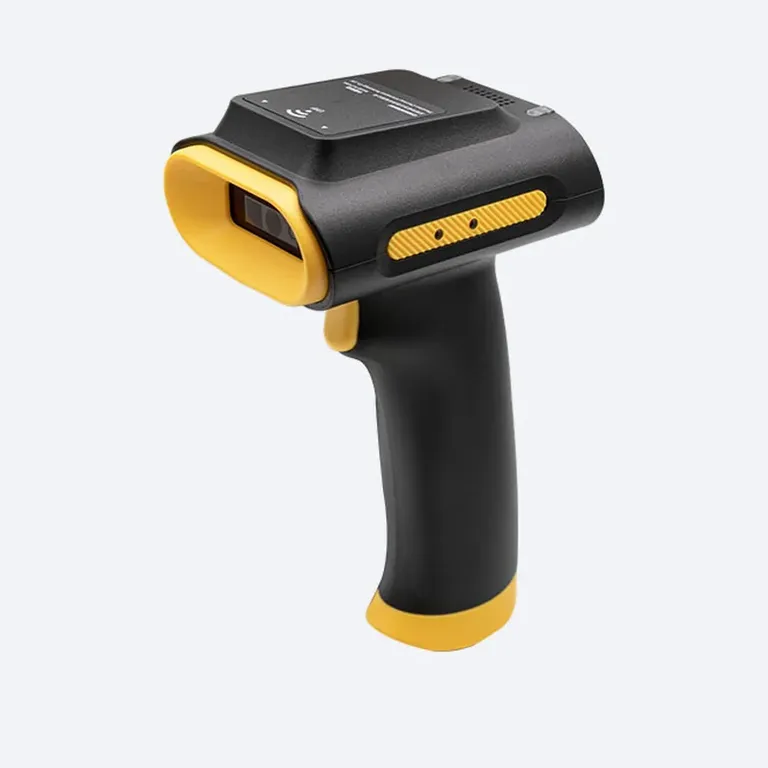
H&M chose the Chainway SR160 UHF RFID scanner, which combines fast UHF RFID reading and 1D/2D barcode scanning in one ergonomic device. Chainway's own module, based on the Impinj E310 chip, supports the Impinj Gen2X protocol, with a read range adjustable from 7 to 100 cm.
At the checkout, the SR160 connects to the POS terminal via USB or Bluetooth and works in two modes:
- RFID checkout (primary mode): most items carry UHF RFID tags. The cashier places them in the scanner's sensing zone, the SR160 detects all tags at once and passes the data to the POS within seconds.
- Barcode scanning (backup mode): if a tag is damaged, unreadable or missing, the SR160 switches to barcode mode automatically, and the cashier scans the printed barcode with the same device.
This removes the need for separate devices and keeps operations reliable throughout the RFID rollout.
Technical highlights
- Two technologies in one device: UHF RFID and 1D/2D barcode scanning.
- High read sensitivity: the Impinj E310-based module performs consistently across varying tag densities.
- Adjustable range (7–100 cm): optimised for close and medium-range checkout scenarios.
- Flexible connectivity: USB, RS-232 and Bluetooth for easy POS integration.
- Cross-platform: works with Windows, Linux and macOS.
- Ergonomic design: the lightweight device reduces cashier fatigue in continuous use.
Implementation and workflow
In the pilot, H&M installed the SR160 in selected high-volume stores, with one scanner connected to the existing POS at each checkout. The cashier's workflow was reduced to two steps:
- Place all RFID-tagged items near the scanner for automatic identification.
- If an item does not register, scan its barcode with the same device.
No additional hardware or process change was needed: the POS receives unified data and updates sales and inventory records in real time.
The result
After several months of operation the results were clear and measurable:
- Checkout time reduced by up to 80% compared with barcode-only systems.
- Error rate (missed or duplicated scans) down by more than 70%.
- Less hardware: one SR160 replaced two separate scanners.
- More efficient staff: less device switching and fewer keystrokes.
- Higher customer satisfaction thanks to faster, smoother checkout.
Data consistency between sales and inventory systems also improved. The unified data flow from RFID and barcode sources gives a real-time view of stock and supports better replenishment decisions.
With an "RFID first, barcode as backup" workflow, H&M sped up checkout without compromising accuracy or reliability. The project shows how retailers can move from barcode-based operations to RFID step by step, without disrupting the store.